Diesel injector failures and leaks are common issues reported by owners of the 2015 Ford Ranger T6, particularly those equipped with the 2.2L and 3.2L Duratorq TDCi diesel engines. These problems may manifest in various forms, including internal and external leaks, injector seat blow-by, and electrical malfunctions, often leading to performance degradation and drivability concerns.
Common Symptoms
Symptoms of faulty or leaking diesel injectors may include:
-
Hard starting or no start, especially during cold conditions
-
Misfiring or engine knocking under load or idle
-
Black smoke from the exhaust due to poor fuel atomization
-
Strong diesel odor in the engine bay or cabin
-
Fuel dilution in engine oil, resulting in increased oil levels
-
Ticking or rattling noise from the injector area
-
Check Engine Light (CEL) activation with diagnostic trouble codes (DTCs)
-
Reduced fuel efficiency and increased consumption
Causes
Several factors can contribute to injector failure or leakage:
-
Worn seals, O-rings, or copper washers: Degraded sealing components can lead to combustion blow-by and carbon buildup around the injectors.
-
Contaminated diesel fuel: Water or debris in fuel can damage injector nozzles and solenoids.
-
Faulty wiring or electrical connectors: Disrupted signals can impair injector function.
-
Overfueling by ECU: Poor calibration can stress injector components.
-
Improper installation: Incorrect torque or seating may cause leaks or injector movement under pressure.
Diagnosis
Common diagnostic methods include:
-
Visual Inspection: Removal of engine cover to check for carbon deposits, fuel stains, or physical damage.
-
OBD-II Scan: Retrieval of fault codes such as P0201–P0204 (injector circuit) or cylinder imbalance codes.
-
Leak-Off Test: Measures return fuel flow to detect internal injector leakage.
-
Compression Test or Injector Blow-by Test: Identifies combustion gas leakage at the injector seat.
-
Engine Oil Analysis: Detects diesel contamination in oil.
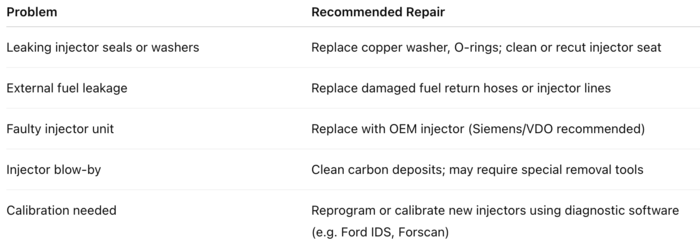
Repairs and Solutions
Prevention
To minimize the risk of injector issues:
-
Use clean, high-quality diesel (Euro 5 or higher if available).
-
Replace the fuel filter regularly (every 20,000–30,000 km).
-
Use diesel fuel additives or injector cleaners periodically.
-
Avoid long idling and short trips that promote carbon buildup.
-
Check engine oil level and quality frequently.